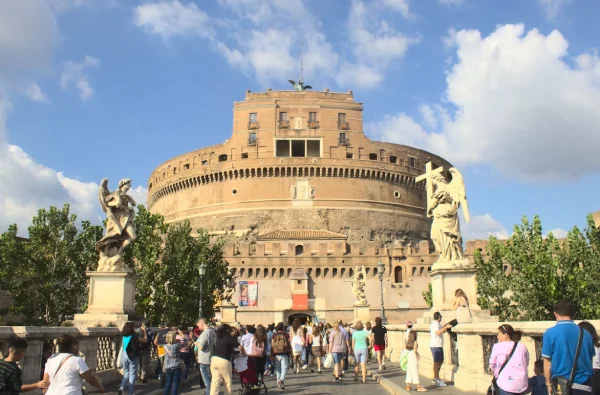
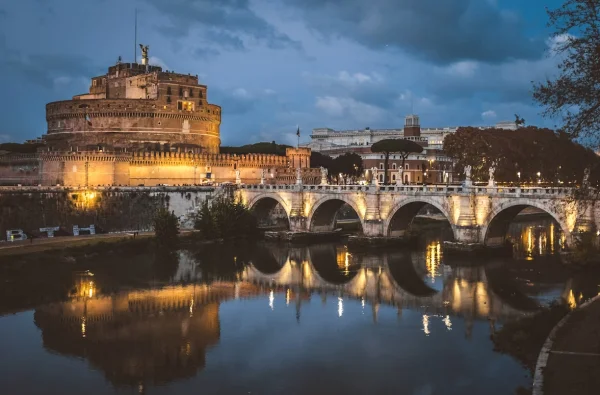
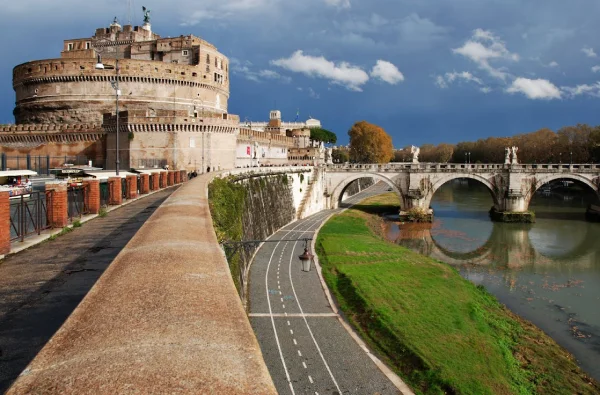
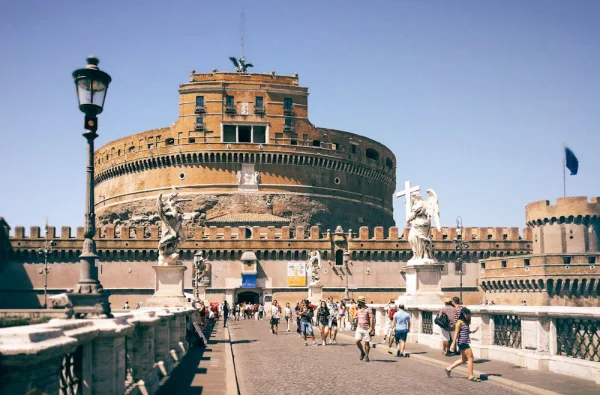
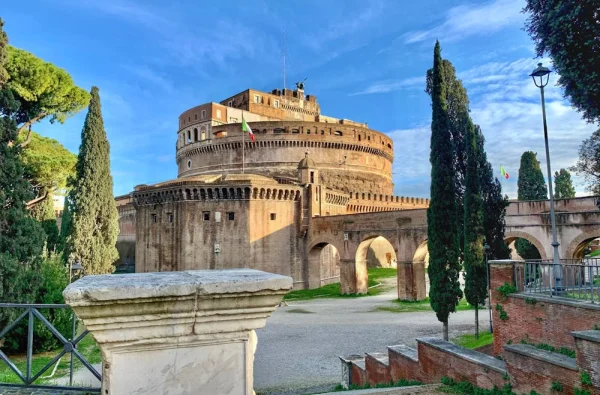
Castel St. Angelo’s interior is a labyrinth of seven distinct levels, each one revealing a different chapter in the castle’s transformation from imperial tomb to military fortress to Renaissance palace.
Support when you need it
Customer service to help you with all your needs from 8:00 a.m. to 7:00 p.m.
Fast and online booking
Choose the best option for your needs and preferences and avoid the lines.
Top attraction in Rome
Explore a true symbol of power, history, and art in the heart of Rome.
Inside, you’ll find everything from the original Roman spiral ramp that once carried funeral processions to opulent papal apartments covered in Renaissance frescoes, dark prison cells that held some of history’s most fascinating characters, and a rooftop terrace with arguably the best 360-degree view in all of Rome. As you can see, it’s not your typical museum visit.
Here’s the thing: the castle wasn’t designed with clear “floors” in mind. What you see today is centuries of additions, modifications, and transformations stacked on top of each other. The modern division into seven levels is really just a practical framework to help you navigate what is essentially an architectural palimpsest, a building where each era wrote, erased, and rewrote its purpose.
The castle grew organically according to the needs of each period. That’s why you might see different numbering systems in various guidebooks (it’s not an error, it’s just the reflection of how complex this structure really is).
Quick overview of what you’ll find on each level:
Your journey starts where it all began, at the foundation of Emperor Hadrian’s mausoleum from the 2nd century AD.
The Ambulacro di Bonifacio IX is a circular corridor that wraps around the central cylinder of the mausoleum. Look, it’s ancient Roman construction, but what you see now owes its appearance to Pope Boniface IX in the late 14th century. When he excavated the surrounding ground to isolate the castle’s core for defense, he exposed the original imperial foundation walls.
Then comes the Dromos, the original entrance to the tomb. Picture this: an imposing barrel-vaulted vestibule built with massive travertine blocks that were once completely covered in precious marble. This passageway was designed for solemn funeral processions making their way to the heart of the tomb. At the end sits the Atrium, a square chamber where a colossal statue of Emperor Hadrian once stood in a niche that’s still visible today.
But the real showstopper on this level? The Helical Ramp.
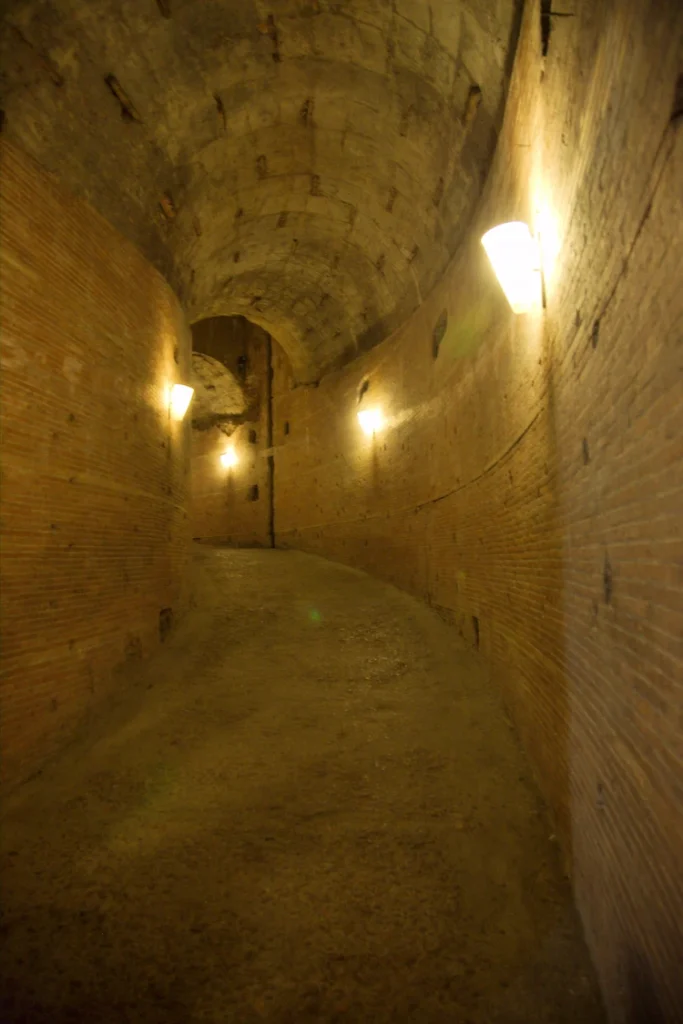
This is one of the most spectacular pieces of Roman engineering you’ll encounter anywhere. It’s a wide, gently sloping spiral corridor that winds upward for 120 meters through the concrete cylinder. Originally, it was built to allow imperial funeral processions to reach the burial chamber with dignity and ceremony. The slope is so gradual, the design so clever, that centuries later, it could accommodate troops, horses, and even artillery pieces moving to the upper levels.
Pro tip: Stop as you’re climbing and look up. The perfect curve and dizzying symmetry of the passage create a unique photographic perspective.
The Courtyard of Executions (Cortile delle Fucilazioni) sits in the northeast corner of the square base. The name tells you everything. For centuries, this austere space served as the site for capital executions that needed to happen away from public eyes. The contrast between this grim courtyard and the magnificent Roman structure surrounding it is striking.
Right next to it, you’ll find the Chapel of the Condemned. Its history perfectly captures how the castle constantly repurposed its spaces. In the 17th century, this was a portico used as a gunpowder storage facility. By the mid-18th century, it had been consecrated as a chapel for prisoners awaiting execution in the adjacent courtyard.
As you ascend from the Roman core, you emerge into the spaces that defined the castle’s medieval and Renaissance identity: an impenetrable military fortress.
The Marcia Ronda is the patrol walkway that runs along the top of the outer walls, following the perimeter of the mausoleum’s original base. For centuries, sentinels walked this path, connecting the four massive corner bastions while keeping watch over the surrounding area. From here, you get your first real panoramic views and start to understand just how strategically positioned this building is.
On the other hand, Four Evangelical Bastions are impossible to miss. To adapt the ancient structure to the age of gunpowder and cannons, four imposing pentagonal bastions were built at the corners of the square enclosure between the 15th and 16th centuries. Named after the four evangelists (San Matteo, San Marco, San Luca, and San Giovanni) these brick ramparts wrapped around, and in some cases completely concealed, the earlier medieval towers, creating a formidable defensive platform.
Now, let’s talk about the Passetto di Borgo, one of Rome’s most legendary structures.
This is an 800-meter elevated and fortified corridor that connects Castel Sant’Angelo directly to the Vatican Palaces. Built in 1277 by order of Pope Nicholas III, it was designed as a quick and secure escape route for the pontiff in case of siege. And believe me, it proved its worth dramatically in 1527 during the Sack of Rome. Pope Clement VII used it to flee from the imperial troops of Charles V while the Swiss Guard sacrificed themselves to protect his retreat. It’s the kind of historical moment that makes your skin prickle.
Fair warning: Access to the Passetto is very restricted. It generally opens to the public only on special occasions or through specific guided tours that must be booked well in advance. If you get the chance, take it.
The Hall of Urns (Sala delle Urne) sits at the center of this level, and visiting it is genuinely moving. This square room, built with enormous travertine blocks, is the heart that the entire Roman structure was designed to protect. It once held the cinerary urns of Emperor Hadrian, his wife Vibia Sabina, and their successors up to Caracalla. The walls, now bare, were covered in the most precious marbles.
But here’s what makes this space so powerful: it’s empty. In 410 AD, during the sack of Rome by Alaric’s Visigoths, the tomb was desecrated and the imperial ashes scattered, putting a definitive end to its funerary function. What you’re standing in isn’t just an empty room, it’s the epicenter of a monumental historical shift. You’re witnessing the physical evidence of an empire’s fall and a sacred sepulcher’s violent transformation into a military bastion.
Symbolically descending into the building’s entrails, this level reveals the castle’s darkest and most pragmatic side. Its function as a state prison and as a self-sufficient fortress capable of withstanding prolonged sieges.
At this level we find the Historic Prisons here were synonymous with terror and despair for centuries. Enemies of the papacy, heterodox thinkers, artists, and fallen nobles all suffered within these walls.
Among the famous prisoners: philosopher Giordano Bruno, burned at the stake for heresy; Beatrice Cenci, a young noblewoman executed for plotting to murder her abusive father in one of the Renaissance’s most tragic Roman stories; and the multifaceted artist Benvenuto Cellini. Cellini’s imprisonment gave rise to one of the castle’s most famous anecdotes. In 1538, the sculptor achieved a spectacular escape by lowering himself down the outer walls with a rope made from knotted bed sheets. You have to admire the audacity.
The most feared of all the prisons was known as the Sammalò or San Marocco. It wasn’t even a constructed cell—it was one of the ancient air vents from the Roman helical ramp, repurposed as a dungeon. The prisoner was lowered through a trapdoor from above into a space so narrow they couldn’t stand upright or lie down, condemned to remain in a hunched position in absolute darkness. Take a moment when you’re in these cells. With the right light, you can still make out faint engravings and graffiti left by prisoners.
The Grain and Oil Warehouses (Oliare e Granai) demonstrate the fortress’s logistical planning. Survival during a siege depended on provisions. In the courtyard, you can see five large circular wells dug directly into the thick concrete drum of the original Roman structure. These silos, filled through openings in the floor of the rooms above, stored grain, oil, and other essential provisions. It’s a fascinating detail that reveals how the mausoleum’s core didn’t just serve as a foundation, its very mass was hollowed out and reused, pragmatically adapting ancient engineering to medieval military needs.
Here, architecture starts speaking a language of power, culture, and comfort, not just defense.
First, the Courtyard of the Angel (Cortile dell’Angelo), an elegant rectangular courtyard from the 16th century that functions as an open-air vestibule, providing access to the papal apartments. Its name comes from the statue presiding over its center: the original marble angel that crowned the castle for more than two centuries. Created in 1544 by Raffaello da Montelupo, it was replaced in the 18th century by the current bronze statue you’ll see on the upper terrace. Getting to see this work up close, when it was once visible only from a distance, is quite special.
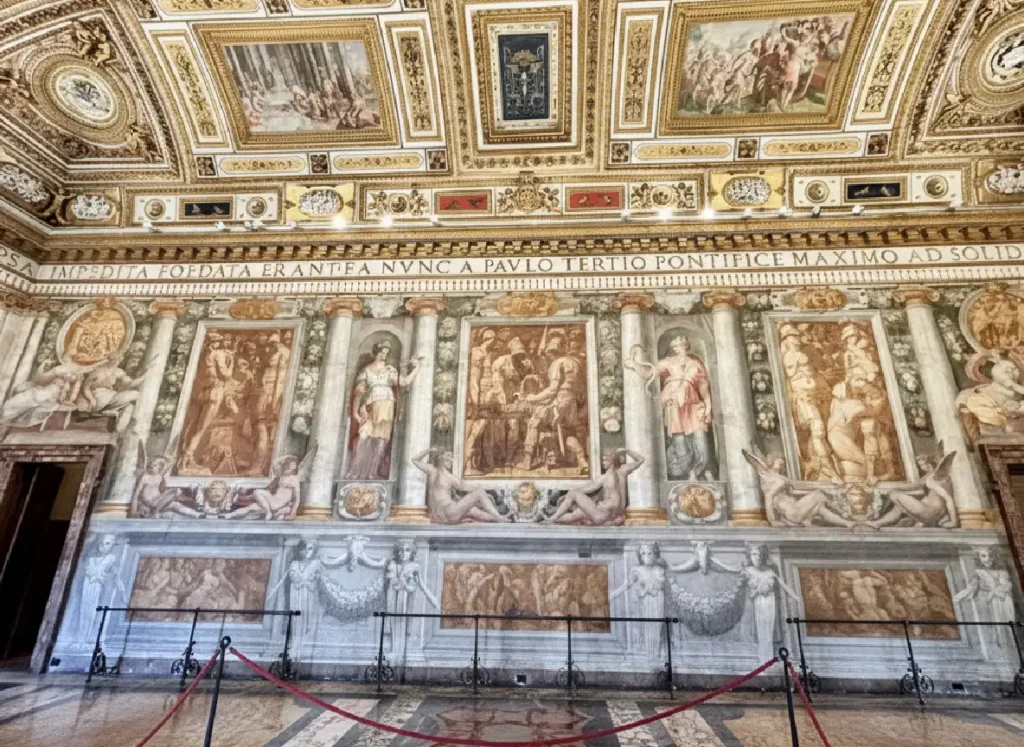
Next, the Hall of Justice was used for papal court hearings, a reminder that the castle also served as the judicial headquarters of the Papal States, and the Hall of Apollo, one of the castle’s artistic gems. Its walls and vault are covered with splendid frescoes in the “grotesque” style, created by the celebrated artist Perin del Vaga and his workshop in the mid-16th century. This decorative style, with its fantastic creatures, garlands, and imaginary architectures, was directly inspired by the frescoes discovered shortly before in the ruins of Nero’s Domus Aurea.
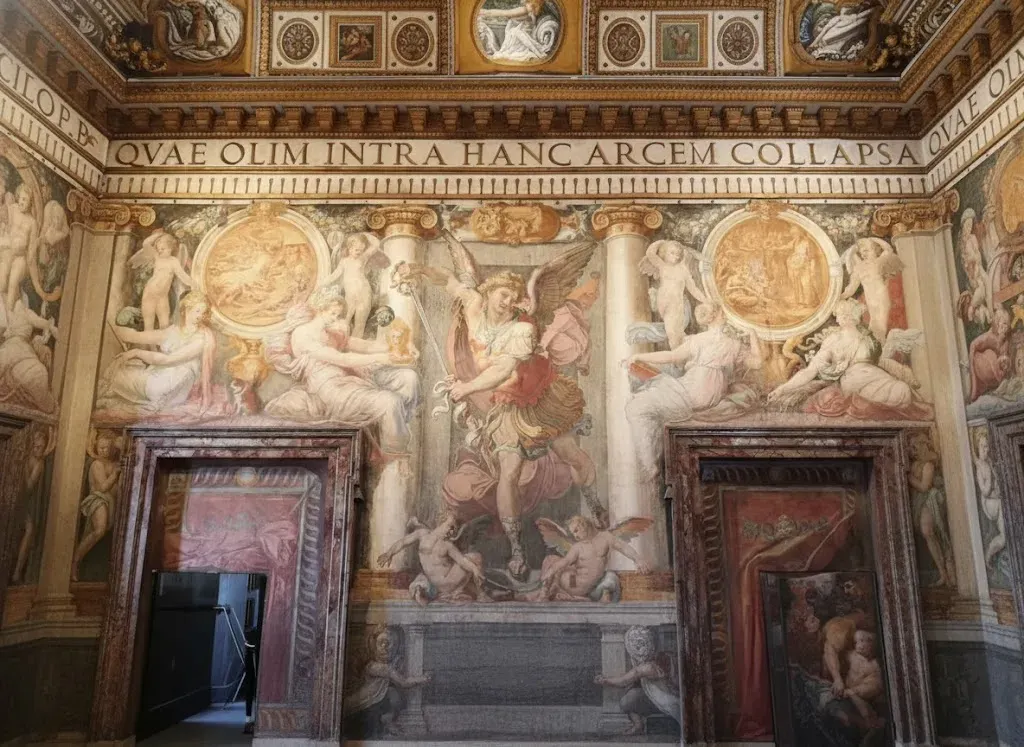
And finally, the Apartments of Alexander VI (Borgia) and Clement VII (Medici), which you can see in the image above, show the growing desire for luxury and comfort. Particularly notable is the Stufetta, or Clement VII’s Bathroom: a small, exquisite bathing room decorated with mythological frescoes by Giulio Romano, a disciple of Raphael. This intimate space, designed for pleasure and personal care, contrasts radically with the austere military functionality of the lower levels and symbolizes the definitive change in the castle’s use.
This level represents the pinnacle of Castel Sant’Angelo as a Renaissance palace. These are the apartments commissioned by Pope Paul III Farnese in the mid-16th century, a suite of rooms of extraordinary artistic richness and symbolic significance, designed to dazzle and project the magnificence of his pontificate.
The Loggias of Julius II and Paul III demonstrate the transformation from fortress to palace through the opening of walls to the outside. These elegant porticoed galleries offer spectacular views of the city and river. They’re no longer mere watchtowers, but spaces for recreation and contemplation. The loggia is one of the best spots in the castle for photography. At sunset, golden light bathes the Ponte Sant’Angelo and St. Peter’s dome, creating an unforgettable image of Rome.
The Paolina Hall is considered the masterpiece of the Farnese apartments. This was the grand reception hall where the Pope received ambassadors and dignitaries. The decoration, directed by Perin del Vaga, is a complex iconographic program designed to glorify Paul III. The frescoes narrate episodes from the lives of his patron saints, St. Paul and St. Peter, and his historical namesake, Alexander the Great.
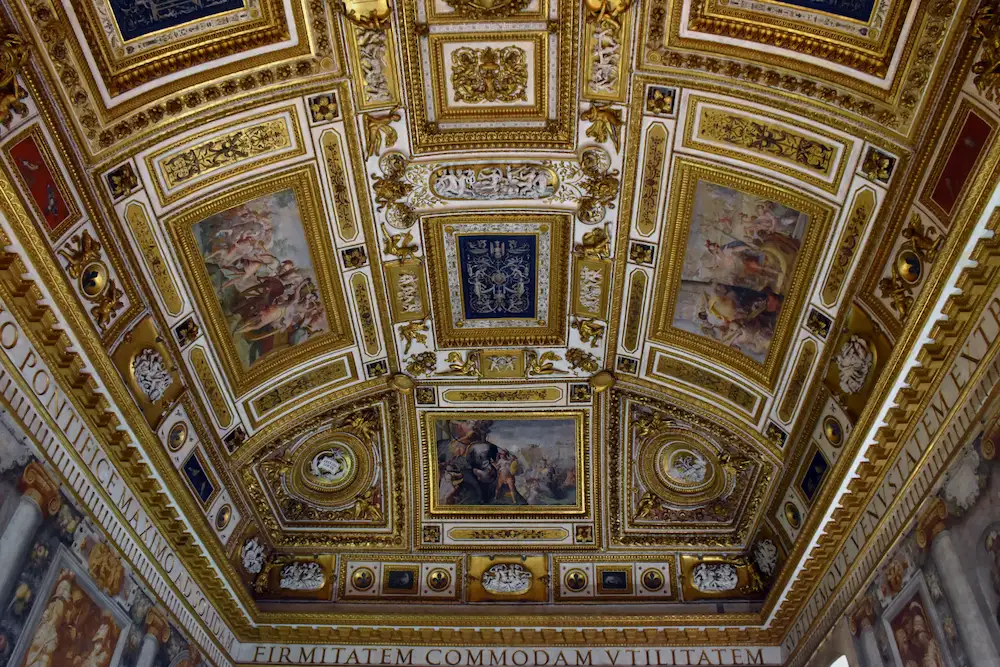
Next, the Perseus Room was Paul III’s private study. The frieze decorating it represents the myth of the Greek hero Perseus. The theme wasn’t chosen randomly. Perseus’s story, who with his intelligence and the gods’ help defeats the monstrous Medusa, who turned onlookers to stone, was interpreted as an allegory of reason and faith (the Pope) triumphing over the irrational forces of heresy (the Protestant Reformation).
The Hall of Cupid and Psyche (Amore e Psiche) was the papal bedroom. At first glance, the decoration might surprise you: it narrates the pagan and sensual fable of Cupid and Psyche, taken from Apuleius’s novel “The Golden Ass.” Why such a carnal love story in a pontiff’s bedroom? Through the lens of Christian Neoplatonism, which was highly influential in the Renaissance, Psyche (whose name in Greek means “soul”) represents the human soul. The harsh trials and sufferings she must overcome to finally unite with her beloved Cupid (divine love) symbolize the soul’s arduous path to salvation and union with God. The papal court transformed a pagan tale into a profound theological meditation, demonstrating the Renaissance’s ability to absorb and reinterpret classical culture within a Christian framework.
This level housed the brain and the safe of the Papal States. Here, the most secret documents were kept, along with the Church’s treasure and, occasionally, the most important prisoners.
Pompeian Corridor owes its name to its exquisite “grotesque” decoration, which evokes the frescoes discovered in Pompeii and the Domus Aurea. Decorated between 1545 and 1546 by artists from Perin del Vaga’s circle, like Luzio Luzi, it demonstrates the persistence of this classicist fashion in the papal apartments.
Nearby is the Library Hall, the main room on this level. Its name doesn’t come from housing a book collection for reading, but from its function as an antechamber to the Archivum Arcis, the papal Secret Archive, kept in adjacent rooms. The decoration underscores its importance: above the large marble fireplace, two imposing allegorical figures represent the Church and Rome flanking Paul III’s coat of arms, a clear manifesto of the papacy’s spiritual and temporal power.
On the other side, Treasury Hall sits in the very heart of the Hadrianic cylinder and was the castle’s vault. Protected by thick walls and multiple doors, this is where the papal treasure and most valuable documents were kept. In the center of the room, you can still see the enormous iron chests commissioned by Pope Sixtus V, secured with a complex system of six locks whose keys were held by different high-ranking officials, ensuring maximum security.
Some scholars hold the fascinating theory that this room, due to its central and protected location, might have been Emperor Hadrian’s true original burial chamber.
La Cagliostra is known as the “luxury prison.” Built in 1543 as an open loggia with exterior views, in the 18th century its arches were walled up to convert it into a prison for high-ranking inmates. Its name comes from its most famous prisoner, the enigmatic adventurer, alchemist, and Freemason Count Cagliostro, imprisoned here by the Inquisition in 1789.
The great irony? Despite its prison function, the walls still preserve the delicate original grotesque decoration by Luzio Luzi and Perin del Vaga, creating a strange contrast between artistic beauty and the misery of its later purpose.
The last thing we can see at this level is the Castellan’s Apartment, recently opened to the public, was the residence of the Castellan (the castle’s highest military authority responsible for its operation). Built in the 1730s by order of Castellan Zenobio Savelli Palombara, it consists of several rooms on two levels. The three visitable upper rooms preserve Rococo-style frescoes attributed to Pier Leone Ghezzi. Currently, this space houses a permanent exhibition about the Girandola, the legendary fireworks display launched from the castle on special occasions, a tradition that fascinated Rome for centuries.
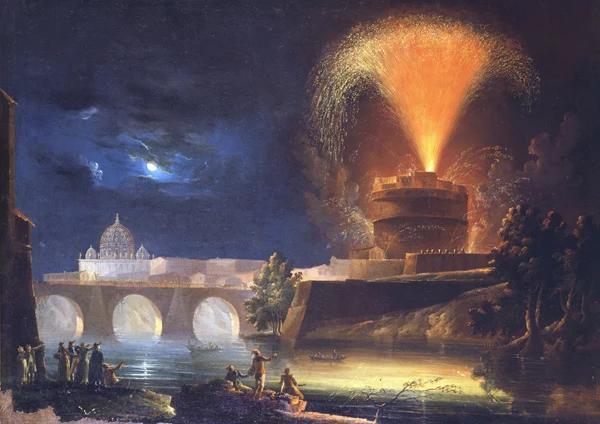
The journey culminates at the castle’s highest point, a place of immense symbolic power that offers the final reward: an unforgettable panoramic view of Rome, the Eternal City.
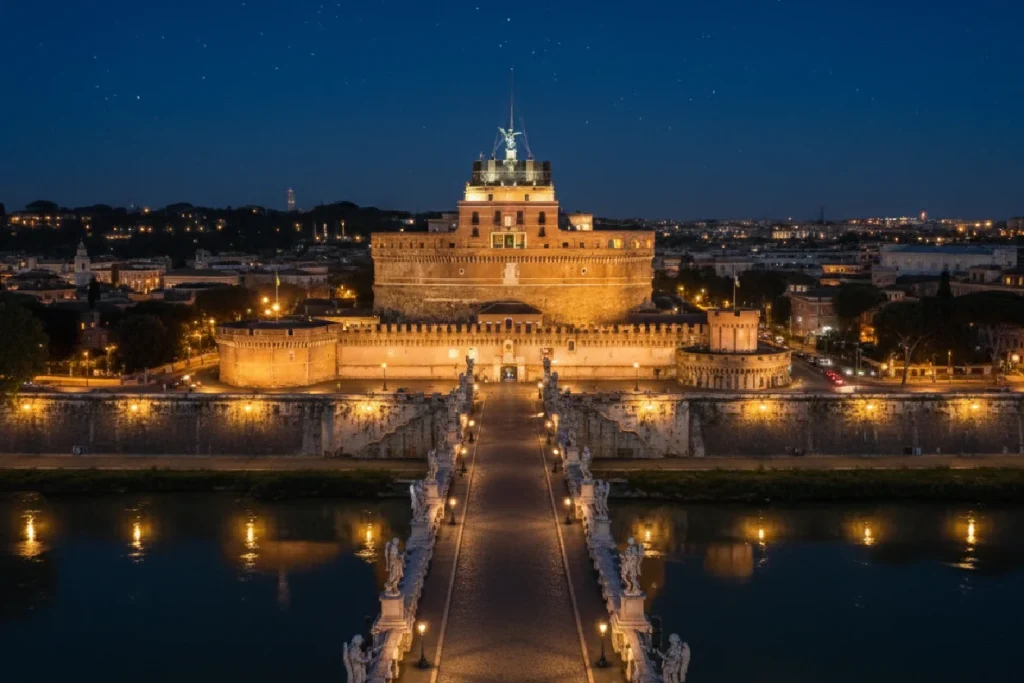
In the Round Room and the Hall of Columns, we find the last interior rooms before going outside. The Round Hall occupies the top of the central Roman tower, and the adjacent Hall of Columns, from the 18th century, served to expand the papal archives. The Round Hall, which provides direct access to the terrace, is often used for temporary exhibitions.
The Terrace of the Angel (Terrazza dell’Angelo) is the ultimate destination. The terrace is dominated by the imposing bronze statue of the Archangel Michael sheathing his sword. The work commemorates the legend that gave the castle its name: in 590 AD, while a terrible plague ravaged the city, Pope Gregory the Great had a vision of the archangel above the mausoleum, interpreting it as a divine sign that the epidemic would end. The current statue, by Flemish sculptor Peter Anton von Verschaffelt, dates from 1753 and is the last in a series of angels that have crowned the building throughout history.
To one side of the statue sits the Bell of Mercy (Campana della Misericordia). Its toll didn’t announce happy events—it marked the moment of executions taking place in the courtyard below, adding a somber note to this celestial space.
But the real reward? The 360-degree view.
From here, you command all of Rome: the dome and colonnade of St. Peter’s, the curve of the Tiber with its bridges, and a sea of rooftops, domes, and monuments stretching to the horizon. This viewpoint is where all the castle’s identities converge: it’s the summit of the Roman tomb, the highest watchtower of the fortress, the papal palace’s belvedere, and the site of its Christian baptism.
So you’re short on time or just want to hit the absolute highlights? Here are the 7 things you absolutely cannot miss inside the castle and why they matter.
Look, you can see the castle’s imposing cylindrical profile from all over Rome. The question is: should you actually go in?
Short answer: absolutely yes, but let me tell you why it’s not just another museum checkbox.
First, it’s genuinely different from anything else you’ll see in Rome. You’ve got the Colosseum for ancient spectacle, the Vatican for religious grandeur, the Pantheon for architectural perfection. But Castel Sant’Angelo? It’s the only place where you can walk through a Roman emperor’s tomb, climb medieval fortifications, stand in Renaissance papal apartments, descend into feared prison cells, and end up on a rooftop terrace with Rome spread out beneath you. That vertical journey through time is unique.
Second, it’s not overwhelming. After you’ve spent hours navigating the Vatican Museums or walked yourself into exhaustion at the Roman Forum, the castle offers something more manageable. You can do it justice in 2-3 hours without feeling rushed or museum-fatigued.
Third, the storytelling is visceral. When you’re standing in the Hall of Urns where Emperor Hadrian’s ashes once rested, or looking at the narrow opening of the Sammalò prison cell, or walking the Helical Ramp that funeral processions once climbed, you’re not just reading about history.
Now, the honest part: it’s not for everyone.
If you have serious mobility issues, you should know that the castle involves climbing many stairs and ramps. There are no elevators, and accessibility is limited. The medieval and Renaissance additions weren’t designed with modern accessibility standards in mind (obviously), and while the Roman ramp is manageable, other sections can be challenging.
If you’re the type who wants everything polished and presented with modern interactive displays, this might feel old-school to you. The castle is more “authentic historical structure” than “state-of-the-art museum experience.” Some rooms have informational panels, but it’s not heavily curated in the way some newer museums are.