Castel Sant'Angelo statue
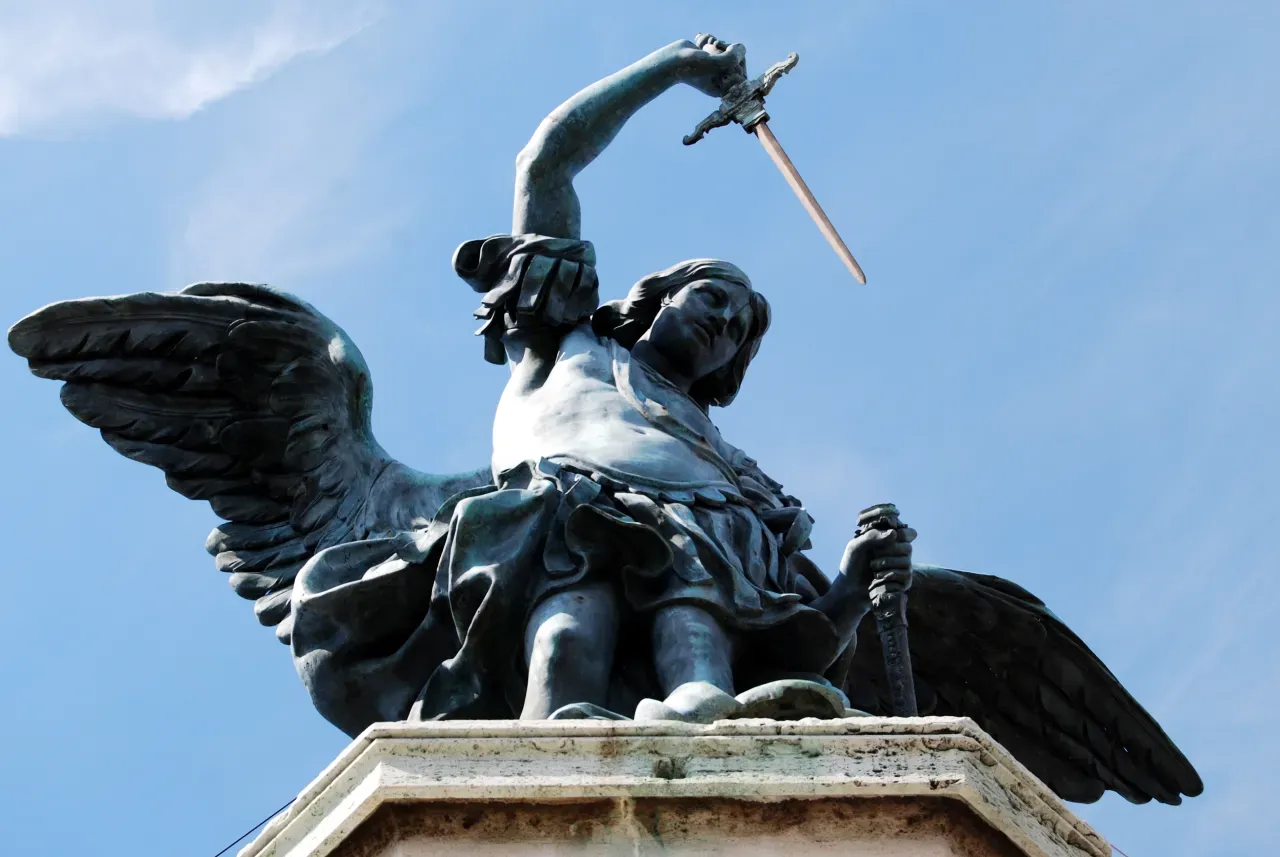
The Castel Sant'Angelo statue is the bronze figure of the Archangel Michael located at the summit of this Roman fortress. The sculpture depicts the angel sheathing his sword to symbolize the end of a devastating plague. This monument serves as a powerful focal point above the Tiber and Bernini’s angel-lined bridge.
Support when you need it
Customer support to help you with everything you need from 8:00 to 18:00.
Fast online booking
Select your ticket for your needs and preferences and avoid the lines booking here.
Top Attraction in Rome
Ascent through the fortress levels to observe the architectural history and the evolution of the city.
What is the statue on top of Castel Sant'Angelo?
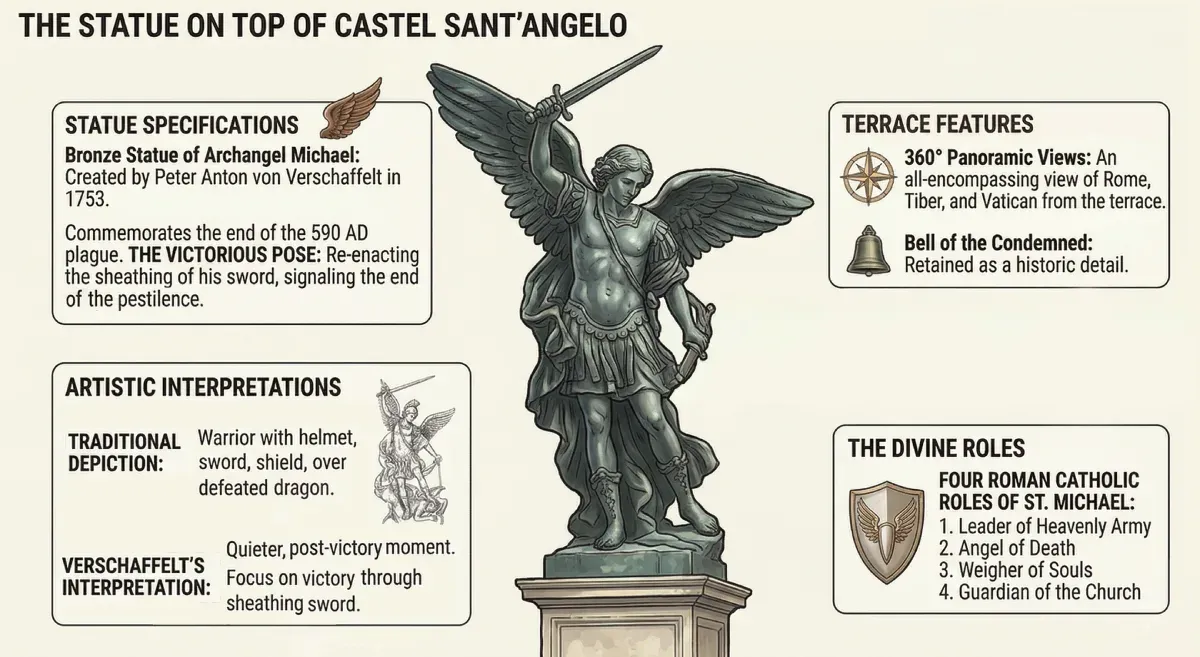
The statue crowning Castel Sant'Angelo is a bronze Archangel Michael created by Peter Anton von Verschaffelt in 1753. Positioned on the castle's uppermost terrace, the figure shows Michael in the act of sliding his sword back into its scabbard, a gesture that marks the moment he appeared above the fortress to signal the end of a plague that had swept Rome.
Michael, also called Michael the Taxiarch, is an archangel recognized across Christianity, Judaism, and Islam as the warrior of God. In Roman Catholic teachings, he serves four main roles: leader of the heavenly army against the powers of Hell, angel of death who carries souls to Heaven, weigher of souls on balanced scales, and guardian of the Church. The statue's pose at Castel Sant'Angelo captures his first role: the military commander who has just won a battle.
In many depictions across art history, Michael appears as a warrior armed with helmet, sword, and shield, often standing over a defeated serpent or dragon. Verschaffelt's interpretation at Castel Sant'Angelo takes a quieter approach: rather than showing a warrior mid-fight, it captures the moment after victory: the sword returning to the sheath, the plague ending, the city saved.
How did the Archangel Michael name the castle?
In 590 AD, a plague affected the population of Rome. Pope Gregory the Great conducted a religious procession toward St. Peter’s Basilica to seek the end of the epidemic. According to legend, the Pope saw the Archangel Michael appear on top of Hadrian’s Mausoleum. The angel sheathed a sword, which signaled the conclusion of the divine punishment. The plague stopped shortly after this event.
Consequently, the people renamed the structure Castel Sant'Angelo to honor the apparition. This narrative explains the transition of the building from a Roman tomb to a Christian fortress.
How the crowning statue of Castel St. Angelo changed over the centuries?
The crowning statue of Castel Sant'Angelo evolved through three primary versions since the Middle Ages. Each iteration utilized different materials to withstand the environmental conditions at the summit of the fortress:
| Period | Post-590 AD |
|---|---|
| Material | Wood |
| Sculptor | Unknown |
| Current Status | Lost due to natural deterioration. |
| Period | 1536 – 1753 |
|---|---|
| Material | Marble |
| Sculptor | Raffaello da Montelupo |
| Current Status | Located in the Cortile dell'Angelo. |
| Period | 1753 – Present |
|---|---|
| Material | Bronze |
| Sculptor | Peter Anton von Verschaffelt |
| Current Status | Remains at the summit of the castle. |
Where can you see the statue and what are the best viewing spots?
The Castel Sant'Angelo statue is accessible from three distinct locations within and around the monument:
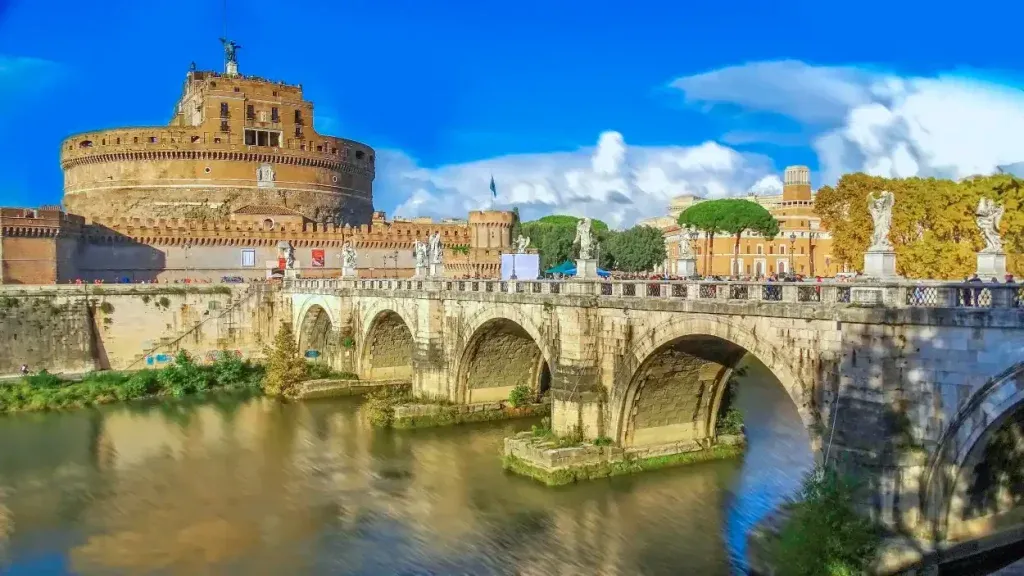
From outside
The Castel Sant'Angelo statue is visible from several points along the Tiber banks, with the primary angle located on Ponte Sant'Angelo. Walking across the bridge toward the fortress, the bronze figure appears above the cylindrical walls.
The Lungotevere Castello riverside road also offers sightlines of the monument against the sky. These external viewpoints allow visitors to observe the statue's scale and its position within the city's architectural landscape. These areas remain accessible to the public at all hours without requiring an entrance fee.
From the terrace
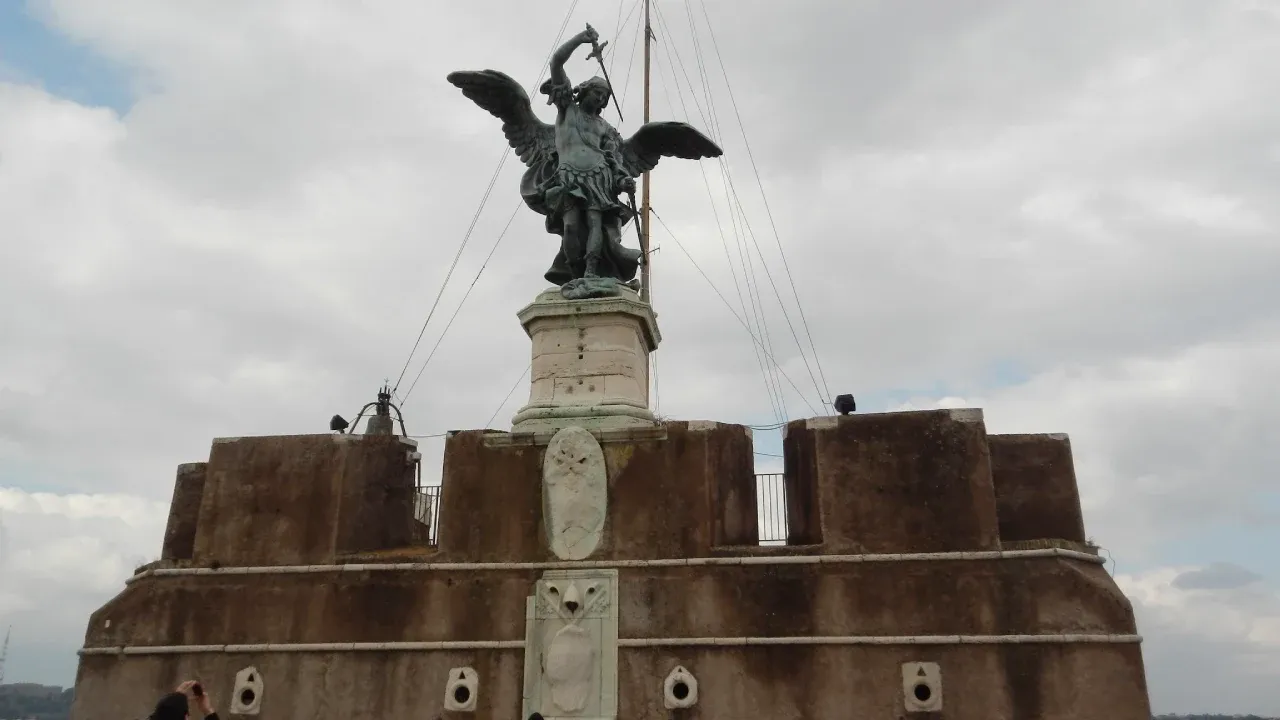
From the terrace
Visitors who enter the fortress can ascend through the internal levels to reach the Terrazza dell'Angelo at the summit. This location provides the closest perspective of the Castel Sant'Angelo statue. From this height, one can observe the textures of the feathers, the facial features, and the detail of the sword.
The terrace serves as a lookout point offering a 360-degree panorama of Rome, including St. Peter's Basilica and the Tiber River. Access to this level requires a standard admission ticket and involves climbing several flights of stairs through the historic structure.
Photo: “Roma, Castel Sant'Angelo - Terrazza dell'Angelo" by Bogdan Tapu.
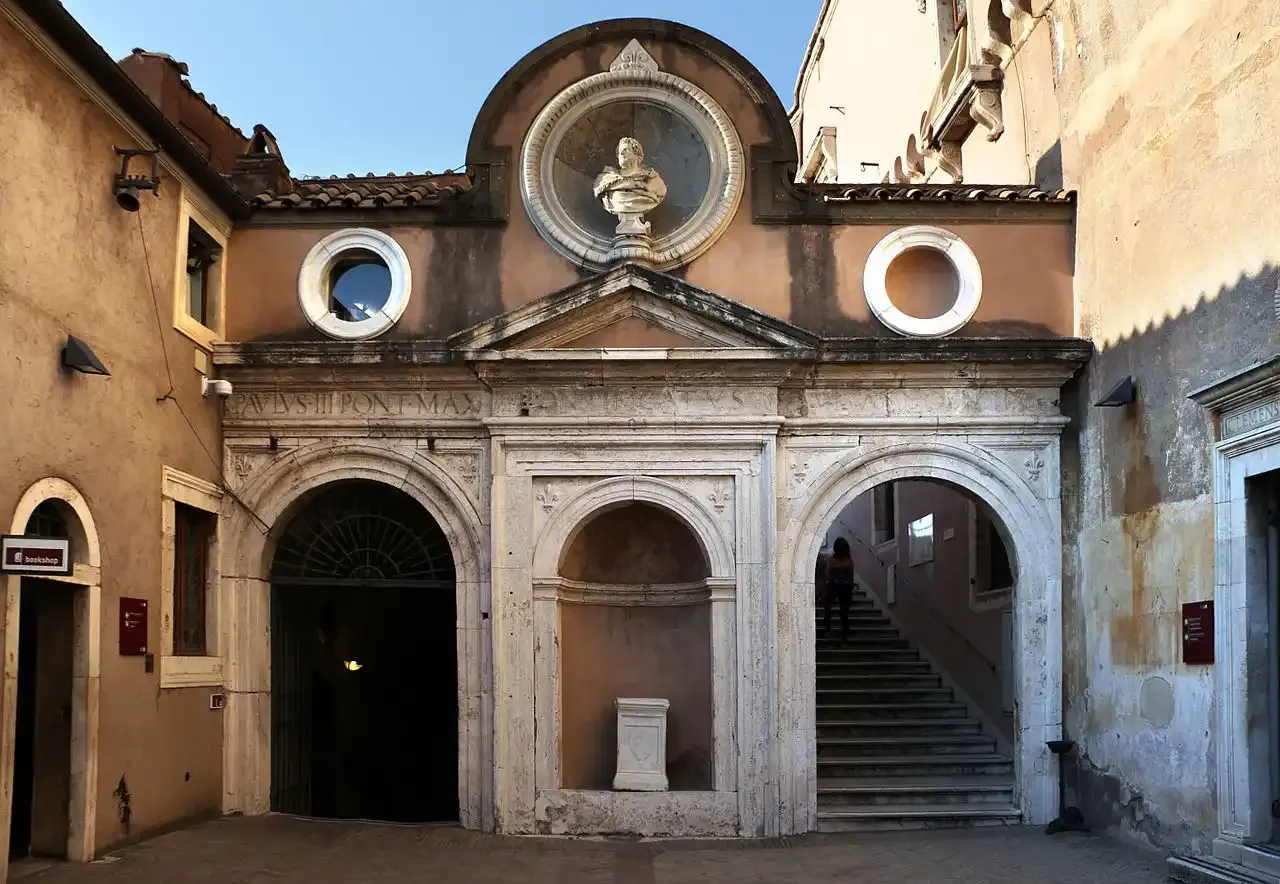
The Montelupo marble inside
To see the predecessor of the current bronze work, visitors must go to the Cortile dell'Angelo on the lower levels. This courtyard houses the original 1536 Castel Sant'Angelo statue carved in marble by Raffaello da Montelupo. This version occupied the summit for over two centuries before its replacement due to structural weathering.
Access to this courtyard is included in the general admission fee for the Museo Nazionale di Castel Sant'Angelo. The transition from marble to bronze represents a significant change in the preservation strategy for the Castel Sant'Angelo statue over time.
Photo: “Cortile dell'Angelo” by Sailko.
Who are the angel statues on Ponte Sant'Angelo?
Gian Lorenzo Bernini, the Baroque sculptor, designed the 10 angel statues that line Ponte Sant'Angelo in 1668-1669, commissioned by Pope Clement IX. Each angel holds an instrument of Christ's Passion (the objects associated with the crucifixion), creating a processional path from the city toward the castle.
Bernini produced the designs for all 10 figures and carved two with his own hands: the Angel with the Crown of Thorns and the Angel with the Superscription (the INRI sign). Pope Clement IX found these two so accomplished that he ordered them kept indoors to protect them from weathering. The originals are now in the church of Sant'Andrea delle Fratte in Rome, and copies by Bernini's assistants stand on the bridge in their place.
The remaining eight angels were carved by sculptors from Bernini's workshop, each responsible for one figure:
- Angel with the Column by Antonio Raggi
- Angel with the Whips by Lazzaro Morelli
- Angel with the Crown of Thorns (copy after Bernini; original in Sant'Andrea delle Fratte)
- Angel with the Sudarium by Cosimo Fancelli
- Angel with the Garment and Dice by Paolo Naldini
- Angel with the Nails by Girolamo Lucenti
- Angel with the Cross by Ercole Ferrata
- Angel with the Superscription (copy after Bernini; original in Sant'Andrea delle Fratte)
- Angel with the Sponge by Antonio Giorgetti
- Angel with the Lance by Domenico Guidi
What other statues and artworks are inside Castel Sant'Angelo?
Beyond the crowning Archangel Michael and the bridge angels, Castel Sant'Angelo houses collections that reflect its centuries of transformation from mausoleum to fortress to papal residence to museum:
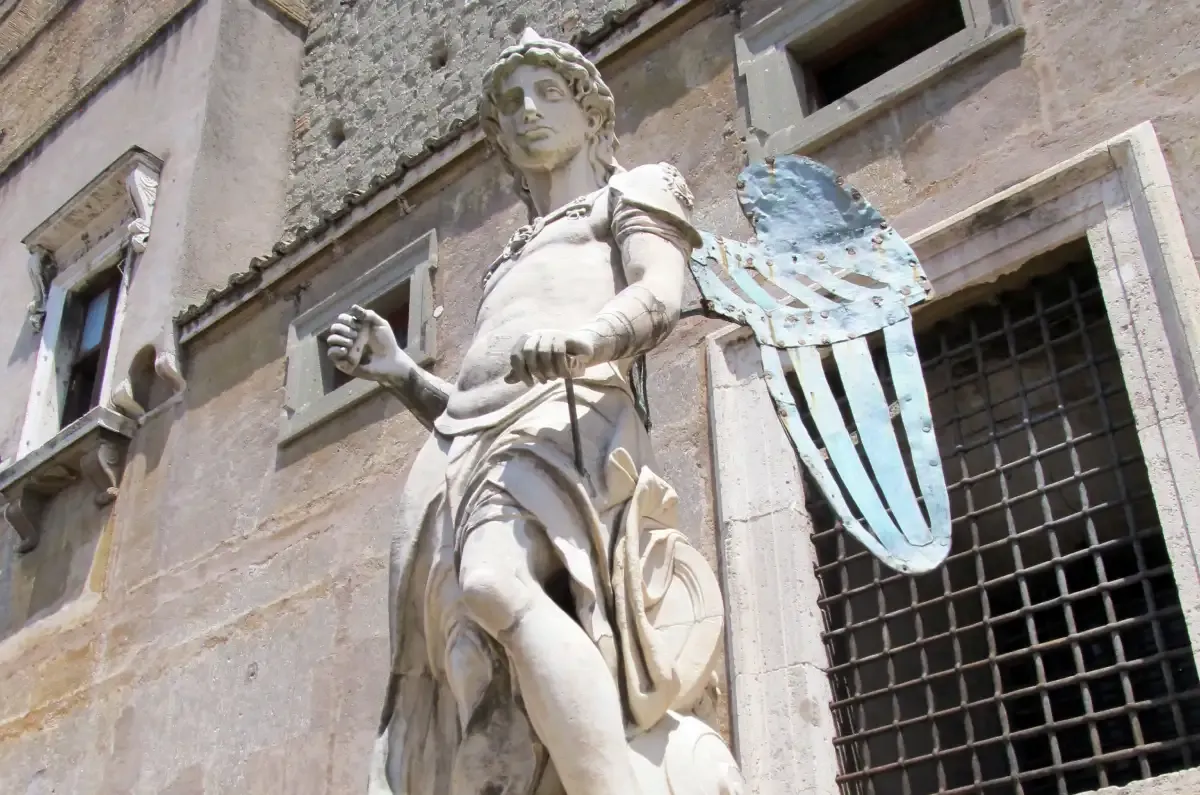
The Cortile dell'Angelo
The inner courtyard, called the Cortile dell'Angelo, is where Montelupo's original marble Archangel Michael now stands after its removal from the rooftop in 1753. The courtyard also stores cannonballs and military equipment from the castle's centuries as a fortification, placed alongside the marble angel in an unusual contrast between sacred art and military hardware.
Photo: “Raffaello da Montelupo Angel” by Jacopo Werther.